Tuesday, November 24, 2009

Pikes Peak in the Clear


The morning of June 3, 2009 brought overcast skies and drizzle to Colorado Springs, CO - dampening my hopes of a clear day on a field trip to nearby Pikes Peak (at 14,110 ft, Pikes Peak is one of Colorado's 54 "14ers"). Assured by the folks who run the Pikes Peak Cog Railroad that the summit was clear, we boarded the train for the ride to the top.
It wasn't long before we broke free of the clouds, and soon were way above treeline in a few inches of new snow! From the summit we were able to look back down toward the cloud covered Colorado Springs and the plains to the east, where it remained cloudy and wet for the rest of the day.

Tuesday, November 17, 2009

Crepuscular Rays


We've all seen them...my friend Donald calls them "God Lights". The the rays of sunlight that seem to radiate out from the sun through breaks in the clouds are more properly known as "crepuscular rays". We see them because sunlight is scattered by dust and other particles in the atmosphere making the air lit by the sun appear brighter than the air that is in the shadow of the clouds. Though the rays are virtually parallel to each other, perspective causes an apparent convergence toward the Sun in the same way parallel railroad tracks seem to converge in the distance.
This image of some bright crepusculars was made late one afternoon in Bedford, NY. Note the particularly dark shadow on the right side of the photo, also parallel to the light rays, cast by the clouds there.

Tuesday, November 10, 2009

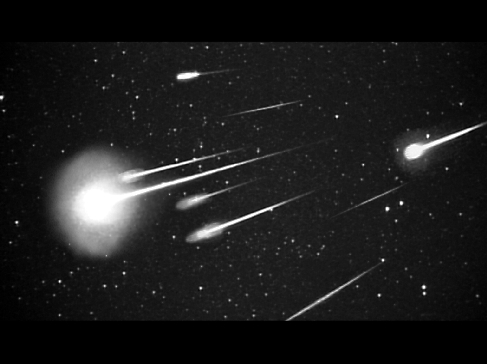
Upcoming Leonid Meteor Shower 11/17-18/2009

This year's Leonids should put on a good show, as the New Moon will not be in the nighttime sky. Peak viewing will be in the wee hours of the night of November 17-18. Here's some good information on how to view meteor showers, and information on all the periodic meteor showers we experience throughout the year.
See the Westchester Astronomers November newsletter for more upcoming sky related events.

Thursday, November 5, 2009

Boring Clams are Interesting!


While attending the Earth Science Information Partners conference at UC Santa Barbara last summer, I enjoyed a nice walk along the beach from the dorms to the conference center each morning. I was struck particularly by the vast number of holes apparently drilled into the rocks along the shore, many of them containing clam shells that just fit into the holes. A closer look at those shells reveals that it's the clams themselves that make those holes!
Examination of the clam shells reveals the sharp ridges visible in the close-up picture on the right. By persistent grinding and rotation of the cutting edges of their shells against the rock, these "rock boring clams" create safe homes for themselves in solid rock, and in doing so accomplish significant weathering of the shoreline rocks, and contribute significant sand to the beach. You can read more about boring clams here:
http://tinyurl.com/boringclams

Sunday, February 1, 2009

The "tilted" crescent Moon

Last week, a friend noticed that the new crescent Moon seemed to be illuminated more nearly on the bottom of the disk of the moon, rather than on the side, and wondered if there was some relationship between that observation and the solar eclipse a few days before.
It turns out that there's no relationship to the eclipse, but rather to the time of the year.
Pretty much, the horns of the crescent coincide with the north and south poles of the Moon, so the waxing crescent pretty much illuminates the "right" side of the Moon (what we call the western limb when viewed from earth), and is centered pretty much on the orbital path of the Moon, and the Moon's equator (not quite, because the Moon's orbit is not quite on the ecliptic). But the illuminated portion of the waxing crescent will appear to be nearer the "bottom" of the Moon as it sets, near the right side of the Moon as it crosses your meridian, and near the "top" of the rising Moon. See the screen shots from http://stellarium.org below:

The Waxing Crescent Moon setting on 1/29/09 (note that the ecliptic is making a fairly steep angle with the western horizon, and that the Moon is north of the ecliptic. The north pole of the Moon is on the "right" side of the moon here, and the Moon's equator is almost vertical:


This was the Moon at meridian crossing on 1/29/09. View is to the south, of course. You could have seen it naked eye if you looked in the right place (you can see Venus naked eye, too!) Notice that the illuminated crescent is pretty much on the right (western limb) side.


Here's the Moon rising on the morning 1/29/09. Notice that the illuminated portion of the Moon is kind of "on top", but that the angle the ecliptic makes with the horizon is less steep than the angle it makes at sunset, so the crescent is not quite as "on top" as it was "on the bottom" when it set.


The places where the celestial equator (blue) and the ecliptic (red) cross are the equinoxes, and the equinox in these images is the vernal (spring) equinox. When the vernal equinox is setting, the angle between the ecliptic and the western horizon is large (the ecliptic is more nearly vertical). When the sun is near the vernal equinox (March and April), the angle between the ecliptic and the horizon at sunset is at its greatest, and Venus and Mercury, if they're east of the Sun (and therefore setting after it), will be high in the sky right after sunset.

Similarly, in September and October as the autumnal equinox rises, the angle between the ecliptic and the eastern horizon at sunrise is the greatest, and around the autumnal equinox Venus and Mercury, if they're west of the Sun (and therefore rising before it), will be high in the sky and well placed for viewing.

The following screen shots show, in order, the rising vernal equinox, the setting vernal equinox, the rising autumnal equinox, and the setting autumnal equinox.

Rising Vernal Equinox (low angle ecliptic)


Setting Vernal Equinox (high angle ecliptic)


Rising Autumnal Equinox (high angle ecliptic)


Setting Autumnal Equinox (low angle ecliptic)


You should also note that the celestial equator makes an angle with the horizon of (90-latitude) (I have Stellarium set to White Plains, NY at 41N), and it remains constant throughout the year.

If you've never imagined it, think of the ecliptic wobbling across the sky each day. And if you can't imagine it, run Stellarium at high speed, and watch it.

Now, back to my friend's question! Eclipses occur as the Moon crosses the ecliptic on its way north or south (called the "nodes" of the Moon's orbit). That's why solar and lunar eclipses come in pairs about 2 weeks apart (a lunar at one node, and a solar at the other), and the eclipse pairs occur every six months or so when the nodes line up with the Sun! The nodes drift with respect to the sun, but in recent years the eclipses have been occurring in the winter and summer. Winter waxing crescents, for the reasons described above, tend to look like they're lit on the "bottom" But watch the crescent moon after the July 22, 2009 solar eclipse....it'll look like this:

Monday, December 8, 2008

A Gibbous Venus...


If you take a look at my post of 12/1, both planets look pretty round. But realizing that Venus goes through a cycle of phases, I wondered if the camera picked up that level of detail. I went back to the original hi res image, and enlarged Venus to get the image posted here. Sure enough, the gibbous phase of Venus is clearly visible in the photo! I'd seen pictures before, but had never observed the phases myself.
Notice that in the 12/1 photo Jupiter, many times larger than Venus and more than 40 times the diameter of the Moon, appears as a small, round dot of light almost 6 times farther from Earth than the Sun - and the nearby Moon was just "passing through" on it's monthly revolution around Earth.

Saturday, December 6, 2008

Amazing Lenticular Clouds over Mt, Rainier


Folks around Mt. Rainier in Washington state were treated to a spectacular display of "lenticular clouds", formed as a wave of moist air moved over the peak on 12/5/2008. Komonews ran a short article which included some fantastic pictures.

You can find a brief explanation of lenticular clouds here on Wikipedia.

Some years ago, I photographed a lenticular over the Adirondack Mts. that was later featured as an Earth Science Picture of the Day.

Sometimes a similar process produces clouds as stable air moves over a rising column of air. I stopped along the Taconic Parkway one summer evening to photograph this example.