Wednesday, October 26, 2011

Cloud Filled Valleys in Pennsylvania


Nearing the end of a red eye flight from California to New York on 10/17/2011, I was treated to this intriguing view of cloud/fog filled valleys as the Sun rose over the northern reaches of the Valley and Ridge Province of Pennsylvania. Overnight temperatures in the valleys had dropped to the dew point and below the stream water temperature. Under those conditions moisture evaporating from the warmer streams quickly condensed to fill the valleys with fog and clouds, some rising high enough to catch light from the rising sun.
The metar above, covering Sunday 10/16/2011 through Monday 10/17/2011 at Williamsport, PA reveals the cool, saturated, and still air that was in place around sunrise on Monday.

Sunday, March 27, 2011

The Great Tohoku Quake of March 2011

The day after the great M 9.0 Tohoku quake near Honshu, Japan, on 3/11/2011, CNN ran an article with the headline "Quake moved Japan coast 8 feet, shifted Earth's axis" (it was likely based upon this report out of Caltech the day before). The claim seemed too remarkable to be true, and I wrote to a few seismologist/geologist friends for their take on it. A friend at IRIS sent me to the Geospatial Information Authority of Japan, and I searched around for more emerging information.
It turns out that entire island did not move 8 feet, but near the epicenter the movement and deformations of the island and seafloor were even more astounding than the "8 foot" claim.
I've gathered a number of maps, charts, and images pertinent to the quake and put them in a single Google Earth file available here. The links above, and many more, are in the Google Earth file.
Here are some of the truly incredible things that happened during the quake
  • The northeastern shore of the island near the epicenter moved eastward more than 4m during the quake....yes! GPS measurements reveal it! The western part of the island moved eastward by somewhat less than a meter....So part of northern Japan (near the epicenter) is now some 3+m wider than it was prior to the quake! (turn on the japan-slip overlay in the file I sent). I'm assuming that there was significant compressional stress built up in the island, and the land expanded eastward as that stress was released during the quake.
  • The motion along the boundary between the subducted Pacific Plate and the overriding Okhotsk Plate* on was on the order of 24m at the epicenter! (turn on the japan-mainshock-slip overlay in the file I sent). Apparently almost all of the motion was accommodated by the overriding plate moving eastward and up, while the Pacific Plate hardly moved. *(The Okhotsk Plate is part of the larger North American Plate).
  • The upward movement of the plate raised the level of the seafloor just west of the trench an astounding 4.5+m, and created a basin 2+m deep off the shore (turn on the japan-uplift-and-subsidence overlay in the file I sent). The subsidence of the seafloor lowered the island by about 1m along the shore there (which would have the effect of moving the shoreline inland, but not the rocks under it). I don't know this for a fact, but it seems like a 5m rise in the seafloor and a simultaneous lowering of the coastline would have added signficantly to the damage caused by the tsunami.
And here's something I noticed as I looked over these maps. Bring the japan-mainshock-slip overlay to the top of the 3D display by turning it off, and then on again. The dotted isolines are the depth to the interface between the overriding Okhotsk Plate and the subducted Pacific Plate seafloor.

In the Layers panel in the GE sidebar, expand the Gallery folder and turn on Volcanoes.

Now, notice where the volcanoes are relative to the depth of the plate boundary...Seems like the generation of magma that makes it to the surface begins at about 100km depth..... I drew a profile across the area, and collected data to make the annotated chart above.

Saturday, January 15, 2011

Twinkling Sirius


Screenshot from the free planetarium, Stellarium (www.stellarium.org)

If you've watched the night sky much, you've probably noticed how stars seem to twinkle, a phenomenon known as "scintillation".  More careful observation may have revealed that the scintillation is more pronounced in stars near the horizon, and that the planets, while appearing star-like, generally don't twinkle even as the stars around them do!

In my recent post regarding the winter hexagon I described how to locate the bright blue-white star Sirius by tracing the line of stars of Orion's belt down and to the left.  Sirius is the brightest star in Earth's nighttime sky, at least in part because at 8.6 light years distant it is also one of the nearest stars. For observers in northern latitudes, Sirius arcs across the southern winter sky, rising south of east a few minutes earlier each night, and setting south of west about 9 and a half hours later.  By late January Sirius is high in the southern sky by 8 PM (see the image above), and on a clear cold night it puts on a dazzling show, especially if you let your eyes adjust to the dark for a while.  The scintillation will be obvious, and if you look closely you'll see that the color of the star changes too - flashing rapidly from red to green to blue and back again. Here's the explanation:
The star itself neither twinkles nor changes color - those visual effects are the result of the passage of the starlight through Earth's atmosphere on the way to your eyes. 
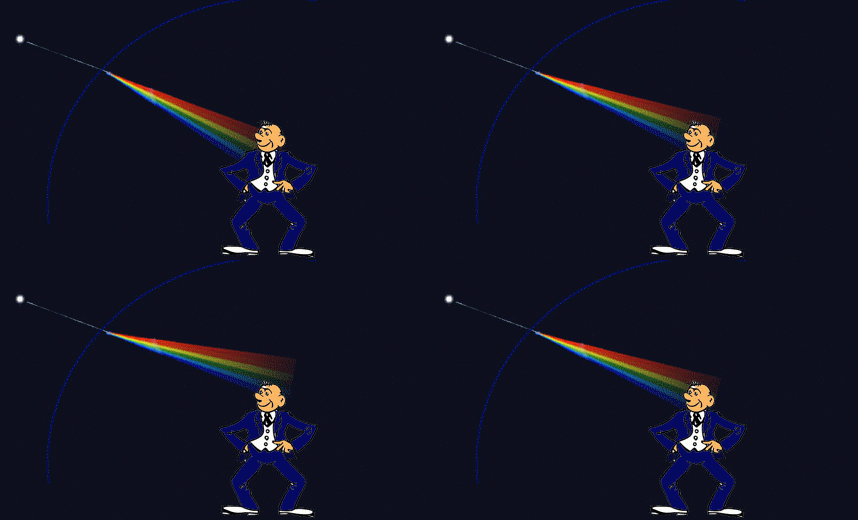
Stars, no matter how large they are, are so far away that even with a large earthbound telescope they cannot be resolved into anything more than a single point of light - we can't observe their surfaces or even resolve them into disks.  When the single narrow beam of light from a star enters Earth's undulating atmosphere, it is bent, or refracted, from its perfectly straight path - first directly into your eyes (making it appear bright) and in the next instant away from your eyes (dimming it) - essentially making it twinkle.
The bright white light coming from Sirius is really a combination of all the colors of the rainbow, and atmospheric refraction can split that light into its rainbow components in the same way a prism does.  The scintillation then directs and redirects the various colors to your eyes:

The scintillation and refraction of Sirius' starlight cause it to twinkle in various colors 
The result is a scintillating, color changing star!  The reason the scintillation is more pronounced near the horizon is that the incoming starlight must pass through more atmosphere before it reaches your eyes. Light from the planets also scintillates, and while they may appear star-like in the sky, unlike stars they actually have some dimension to the them (we can see their disk-like shape). We receive light from many points on the surface of the disk and the scintillation of those multiple beams tends to cancel out the twinkling effect - the planet shines steadily in the sky.  Check out twinkling Sirius and steady Jupiter during the moonless evenings of late January (2011).

Tuesday, December 14, 2010

The Winter Hexagon and a Lunar Eclipse

This image is edited from a Stellarium screenshot.  Stellarium is an excellent, free, planetarium program.  Click for a larger view.
"Orion's Belt", part of the constellation Orion, is a well known and easily recognized asterism in the northern hemisphere's winter sky (between Betelgeuse and Rigel on the image above).  Six bright stars surround Orion's belt forming the Winter Hexagon, outlined in the image above.  Those stars are easy to find on a dark, clear night - follow the line formed by Orion's Belt to the left to locate the bright and twinkling star Sirius, drop down perpendicular to the Belt to find blue-white Rigel, follow the belt to the right to spot Aldebaran (the orange "eye of the bull" in the constellation Taurus).  Look up from Aldebaran to find Capella (in the constellation Auriga), to the left of Capella find Pollux (the brighter of the twins of Gemini), and the sixth star of the hexagon is Procyon, below Pollux on the way back to Sirius.
The Moon passes through the Winter Hexagon each month in its orbit around the Earth, and this month it will be December's Full Moon passing through on the night of 12/20 - 21/2010.  Go out and take a look on Monday, 12/20 - the brightest stars you'll see around the Moon are the stars of the Winter Hexagon. And on this particular night, the position of the Moon marks an important position in the sky...the exact spot the Sun will be on June 21, six months from now - a place in the sky called the "summer solstice".  Tonight's Full Moon will trace the same path across the sky that the summer sun will follow in June!  On this night, too, the Sun is directly opposite the Moon on the other side of the Earth:
 This image is a composite of Google Earth images cobbled together to show the relative locations of the Moon, Earth and Sun during the upcoming eclipse. Click for a larger view

At around 1:30 AM (EST) the Moon will enter the darkest part of the Earth's shadow (called the umbra).  For the next 3 1/2 hours, the Moon will move from right to left through the Earth's shadow, darkened to an orangey-red in the dim light of the Earth's shadow.
If you're willing to stay up, or wake up around 2 AM (EST) on the morning of Tuesdsay 12/21, you can view the last lunar eclipse of 2010.  Worth it, I say!
Here are some photos I took during the lunar eclipse of February, 2008.  That eclipse happened in the constellation of Leo and some of my photos included images of the bright star Regulus (Leo's "heart") and the planet Saturn with its rings tipped toward us.

Sunday, December 12, 2010

The Geminid Meteor Shower

(photo courtesy NASA.gov)
This Monday night (well, actually early Tuesday morning- the night of 12/13- 12/14) marks the peak of the 2010 Geminid Meteor Shower, an event that occurs every year as the Earth passes through the debris stream associated with asteroid 3200 Phaethon (see this NASA article for more on Phaethon and its debris stream).  This year's show is expected to produce up to 120 meteors per hour in the pre-dawn hours of Tuesday, 12/14 - that's a good show!  To view the shower, bundle up and head out any time after midnight (the later the better).  You don't have to look in any particular direction, just up - if you can find a dark place to sit back and look up at the whole sky, that will work the best. The meteors can appear anywhere in the sky, but if you trace their paths backward you'll find that they all seem to come from the constellation Gemini (face to the SSW and look up almost overhead...those 2 bright stars up there are Castor and Pollux, the Gemini twins). Here are some general hints for successful meteor viewing.
Cloudy weather is predicted in the northeast, so check the latest radar before you set your alarm Monday night....

Thursday, December 9, 2010

Earliest Sunset of the Year!

December 8, 2010. Well, we've made it again!.  Tonight is the earliest sunset of the year! The daylight period is still getting shorter (most folks know that shortest day is the Winter Solstice around December 21), but not a lot of people can explain tonight's early sunset.  It turns out that the rate at which the Sun travels across the sky is not constant - the tilt of Earth's axis and its elliptical orbit conspire to push the Sun ahead of our clocks, and then slow it down again, twice every year.  Astronomers call the difference between time told by the Sun (apparent solar time) and clock time (mean solar time) the "equation of time".(If you're interested, you can get the sunrise and sunset times for your location at the US Naval Observatory site.)
The chart on the left above, called the analemma, combines the equation of time with the position of the Sun relative to the equator.  Click it for a larger view, and notice that through most of the fall the Sun has been running ahead of the clock, but in December it began to slow dramatically.
It's the Sun slowing down relative to the clock that's moving the daylight period later into the day even as the days get shorter! (the latest sunrise of the year occurs during the first week of January)
This photo composite was made by Tom Matheson over the course of a year, snapping a picture of the Sun at exactly 8 AM (by the clock) each day.  Here is a labeled image of  Tom's photo.
(This blog is an edited  re-post from December 2009)

Tuesday, March 16, 2010

The Days Are Getting Longer, Fast!

Even the most casual observers have noticed that the days are getting longer fast at this time of year. The table to the right is derived from sun rise and set data provided by the US Naval Observatory for White Plains, NY, and a quick study of the data reveals why.

On 3/25, the Sun will rise 17 minutes earlier and set 10 minutes later than it did on 3/15 - a gain of 27 minutes of daylight in just 10 days!

While the daylight period has been getting longer since the winter solstice on December 21, a look at the Sun rise and set times for late December reveal why those long winter nights seem to drag on for so long...10 days after the solstice, the sun was rising 3 minutes later and setting 6 minutes later, for a hardly noticeable gain of only 3 minutes of daylight!

The geometry of the Sun's path among the stars is responsible for the variability of the change of the length of daylight.  The length of daylight changes quickly around the equinoxes in March and September, and very little around the solstices in June and December.

Notice too that the gains are not symmetrical around noon -  in March the morning gains are almost twice as great as the evening gains, and in December the sun rises later each day even as the days get longer - the lengthening is all in the evening!

This is because the Sun speeds up and slows down relative to the clock (which is in sync with the average time the sun takes to cross the sky). In the spring the Sun is "speeding up" relative to the clock while in December the Sun slows so dramatically that sunrise lags behind the clock even as the days get longer!  This is all a result of both the changing velocity and axial tilt of the Earth in its orbit around the Sun (see this analemma discussion for more information on the relationship between solar and clock time).