Friday, November 28, 2008

Nice View of the Moon, Venus, and Jupiter This Weekend


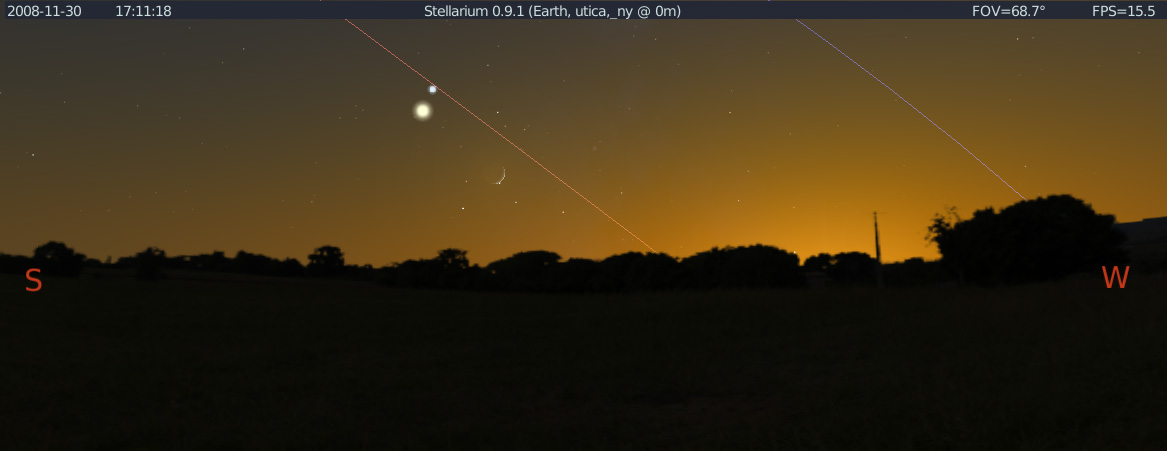
Sunday night (November 30), right after sunset, take a few minutes to view the new crescent Moon approaching Venus and Jupiter in the southwestern sky.
Use your fist held at arm's length to measure the angular distance from the Moon up to Venus (the brighter and lower of the 2 planets)- your fist at arm's length is 10 degrees wide. Here's a Stellarium view of what you'll see - the red line is the plane of the ecliptic.

On the evening of 12/1 (Monday night), the Moon will have moved eastward to a position just to the east of Venus. Using your fist again, estimate how far past Venus the Moon is, and add that measurement to last night's to estimate how far eastward among the stars the Moon has moved in the last 24 hours.

Divide that number into 360 degrees to calculate the approximate number of days it takes the Moon to go through a cycle of phases (called the synodic period*) I'll post my results here next week.

*Here's a diagram that explains the sidereal (one revolution) and synodic (one cycle of the phases) of the Moon. If you measured the Moon's eastward progress against the stars, you could calculate the sidereal period. But since Venus is moving eastward against the stars, too (with the Sun), you're really measuring the synodic period.

Now take a look at this LA Times article, and pay close attention to the image. Can you tell what's wrong? Can you explain how it might have happened?

Monday, October 27, 2008

Stealing Sand from Beaches?


Back in the early 80's when I was building my house, a mason told me to get "Cowbay Sand" to make the mortar for the walls of my foundation - that it was worth the extra expense. He told me that Cowbay Sand came from Long Island, and its characteristic mix of particle sizes and shapes help make a strong mortar. The sand was described this way in a recent Port Washington News report:
The sandbanks of Port Washington are more than 20,000 years old, originating when the final glacier left behind mounds of glacial sand and gravel. Since the 1880s, it has been estimated that over 140 million yards of sand were delivered from Port Washington to New York City; enough sand to cover the Empire State Building with sand extending from the East River to the Hudson River and from 14th Street to 59th Street. The sand, known as Cow Bay sand, was of particularly fine quality and used to construct the sidewalks, skyscrapers, water tunnels and infrastructure of New York City.
There's a neat article from Newsday on the Long Island sand industry here, too.
I wondered then, and still do, is there enough sand around to support all the construction that is constantly going on around us?
It turns out that mining of sand is a big business, and apparently often done illegally, on some Caribbean islands where the demand for sand for construction is so great, and the profits so high, that huge sections of beach are literally being stolen over night.

Tuesday, October 21, 2008

Indian Moon Mission to Launch Late Tuesday Evening

Hi all - I know it's been some time since I've posted here - it was a busy summer and fall for me! This story was simply too good not to post, though.
Late Tuesday evening (New York time), the Indian government will launch a spacecraft headed for the Moon. You can read the article here. Among other instruments, the Chandrayaan 1 is carrying an instrument called the "Mineral Mapper" developed by NASA at Goddard Space Flight Center in Maryland. This is of particular interest because Noah Petro, a 1997 Fox Lane grad, is one of the NASA scientists who worked on the project. You can read a report on the Mineral Mapper, prepared by Noah and others, here. After graduating from Bates College in Maine, Noah earned his PhD in planetary geology from Brown University where he concentrated on lunar geology.
Noah has stayed in touch with FL, and just recently joined Drew Patrick, me, and 2 other Fox Lane grad geoscientists for dinner at the national Geological Society of America meeting in Houston.

Sunday, May 18, 2008

Mt. St. Helens Video in Google Earth


While reading the news this morning, I stumbled upon a nice set of Mt. St. Helens before and after shots, and a link to a time lapse video of the building of the new lava dome. Some of what I saw in the video sent me to Google Earth for a closer look, and as usual things are not quite as simple as they seem.

I put together this kml file http://stevekluge.com/geoscience/ges/Mount St. Helens Questions.kmz , with the video and links embedded, and some placemarks with questions and my amateurish attempts at interpretation.

If you open the file in GE, expand the folder that appears in Temporary Places, and click the icons for the video and each placemark, in order, you can follow my convoluted train of thought.

I welcome any and all comments and interpretations.

(maybe we need a field trip? - the snow is FINALLY melting there)

Thursday, March 6, 2008

A Really Neat Way to View Global Statistics


I thought you all might have some fun, and learn something too, watching this guy talk about global health, economic, and pollution trends over time.

The best part is that you can get that software and play with it yourself. I spent WAY too much time in there, but it is really fascinating to watch trends evolve.

Monday, February 25, 2008

Seeing Stars?


You can contribute to an international scientific study of the nighttime sky! The 2008 GLOBE at Night Campaign will run from 25 February - 8 March.
Your participation involves taking about 20 minutes to observe the sky one evening, and to report your observations on line. See the link above for details. Last year about 20 kids from Fox Lane participated.
2008 marks a monumental shift in human history when more than half the people on Earth are expected to be living in cities. Because of the background light in urban area, many city dwellers have never seen a sky full of stars.
During the 2007 event there were 8,491 observations reported from 60 GLOBE countries, almost doubling the observations from 2006.

Thursday, February 21, 2008

Well, Ms. Zhou, Carl T., and I saw it.....

Here's a shot of the Moon in Earth's umbra taken from Pound Ridge Reservation. The star at Leo's "heart", Regulus, is near the top center of the image, and Saturn appears at the lower left.
More photos are on my flickr page